Early in December 2021, Banksia developed strategies to support individuals living with a life limiting illness to remain at home – both for care, and to die (if preferred).

Background
The Covid-19 Pandemic had a major impact on healthcare across Australia and the world. GPs, hospitals and acute care facilities were not able to provide the same care, in the same way as prior to the pandemic. Banksia clients were not immune to the impact of the constraints and restrictions enforced on health services. Palliative clients were often turned away from emergency departments, as their care needs were not medically life threatening.
During this time of uncertainty, Banksia seized the opportunity to extend the existing clinical model, making an already robust and consistent service more responsive than ever before. A more intent focus on ascertaining and achieving the client and carers ‘goals of care’ was adopted, resulting in purposeful planning to ensure these goals could be achieved within the constraints and challenges imposed by the pandemic. Recognising transfers to hospital for acute, respite or end-of-life care were no longer an automatic option, therefore an alternative was required - a model that had the ability to respond to emergencies and crises efficiently - the Banksia Rapid Assessment Team (BRAT) model was established.
The BRAT attends homes where clients and carers require urgent care/attention (eg. times of acute crises, unmanaged symptoms, escalation of carer distress/burden). An event/concern or issue is escalated to the BRAT via the client/carer or a clinician ‘on the road’ visiting the home. The BRAT members attend the home and address the issue/concern by completing a detailed assessment and instigating interventions where required. The aim of the BRAT is to de-escalate the situation and to support ongoing care in home, preventing the need for emergency services input or transfers to inpatient facilities.
The BRAT framework supports a holistic approach, as it recognises that crises or acute changes do not always require medical input to resolve the situation. The issue/concern and the clients/carers ‘goals of care’ are the primary consideration when the BRAT attend.
The process
The process sees any identified issue escalated to the Nurse Team Leader (NTL) (senior Nurse) on duty. A detailed handover is completed, followed by a thorough assessment of the situation and gathering of additional information, including medications is in the home, medical history, carer’s assessment and the home environment.
The NTL will gather all relevant BRAT members together and provide handover (overview of issue escalated and situation in the home). The BRAT will attend the client’s home for a face-to-face assessment, discuss the GoC and manage the situation accordingly. The client and carer is routinely visited again within 24hrs to reassess. If plan of care was successful, situation and outcome is discussed at Banksia MDM - if not, another BRAT review is completed and the cycle starts again.
The BRAT consists of 4 (four) integral roles:
- Palliative Care Physician - urgent acute symptom/medical change in the client’s condition. Complex symptoms. Medication review.
- Senior Registered Nurse - symptom and/or care change; either client or carer. Requiring prompt assessment as care needs may impact on person’s ability to remain at home. Medication education. Carer’s distress - ability to provide care
- Support and Wellbeing team member - Social Worker &/or Bereavement Counsellor for emotional distress. De-escalate, provide support and counselling.
- Client & Carer Support member - Enrolled Nurse to provide education and carer-support with ‘hands on care’ at home. Bed-based care, generalist care including pressure area, manual handling, mouth care. Respite services.
The impact
Service update
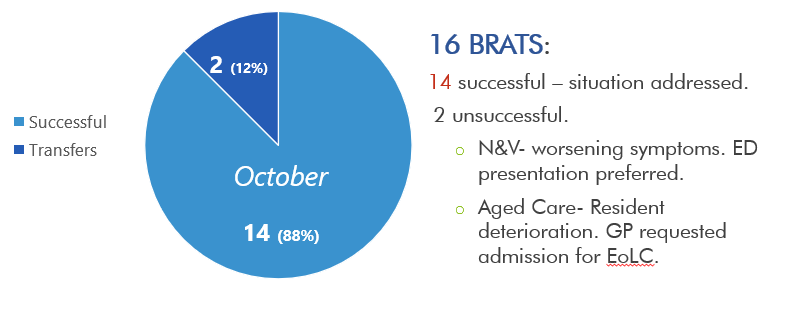
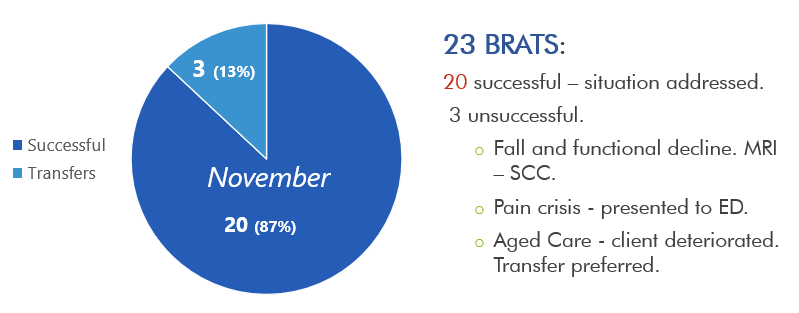
Since implementation in early 2022, the BRAT has become a key component of Banksia’s Clinical Model. This has demonstrably prevented presentations to EDs and unplanned hospitalisations, increased the number of clients cared for at home for end of life, and greatly improved outcomes for carers and families, through the capacity to provide crisis support, when needed.
For further information:
Kylie Johnson, Clinical Operations Manager, Banksia Palliative Care Service
kyliej@banksiapalliative.com.au